
Training and Tapering in High-Level Judo Athletes: A Biochemical and Autonomic Perspective
Campos BT, Cal Abad CC, Rodrigues JGDS, Bachi ALL, Dos Santos CMM, Amaral JB, Penna EM, Prado LS. Training and Tapering in High-Level Judo Athletes: A Biochemical and Autonomic Perspective. Int J Exerc Sci. 2026 Jun 1;19(2):2014.

ABSTRACT
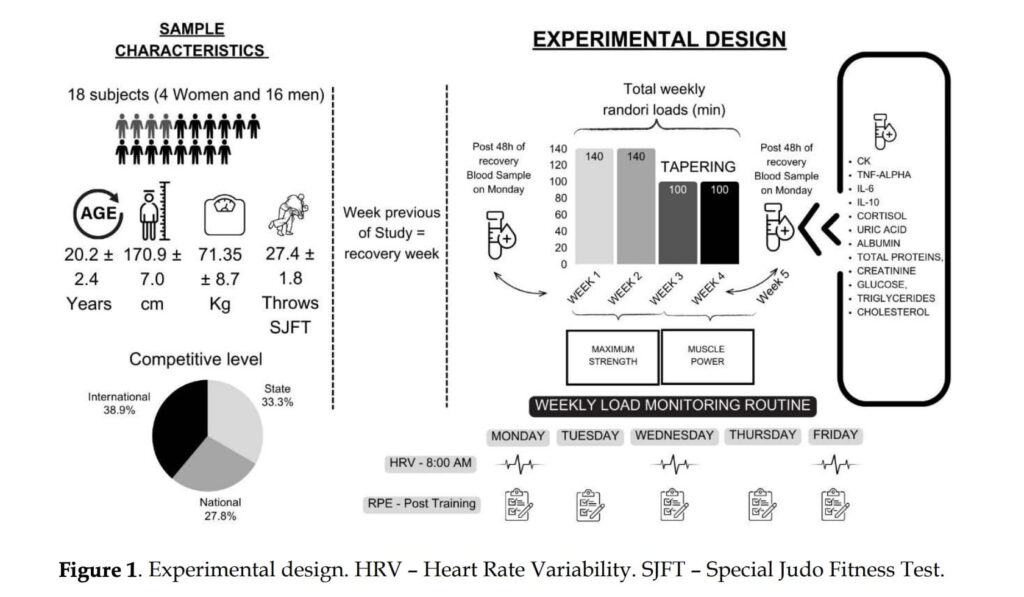
This study aimed to investigate the physiological, metabolic, and inflammatory responses to a four-week systematic training program followed by a 15-day tapering period in high-level judo athletes. Eighteen elite judokas (20.2 ± 2.4 years) were monitored throughout the training cycle. Internal training load was quantified using session rating of perceived exertion (sRPE). Autonomic regulation was assessed via heart rate variability coefficient of variation (HRVcv), while blood samples were analyzed for creatine kinase (CK), creatinine, albumin, total proteins, cortisol, and cytokines (IL-6, IL-10, TNF-α). Training load decreased progressively across the weeks (p < 0.05), confirming a tapering phase. HRVcv remained stable throughout. Post-training analyses revealed significant increases in CK (p = 0.0002), IL-10 (p = 0.01), and creatinine (p = 0.05), while total protein levels decreased (p = 0.01). HRVcv correlated positively with internal load and negatively with albumin and total proteins. Additional correlations were observed between cortisol and total proteins, CK and albumin, and TNF-α with both creatinine and uric acid. Despite initial training-induced stress, the tapering phase facilitated physiological adaptation, as evidenced by autonomic balance and an enhanced anti-inflammatory response. Integrating internal load metrics, HRV, and biochemical markers may improve training monitoring and recovery strategies in high-performance judo athletes.
Keywords: Heart rate variability; biochemical markers; inflammation; muscle damage; training load.
Download the full article HERE.