

Longitudinal changes in body composition and water turnover in a world‐class male judo athlete: A case report
Takubo N, Kondo E, Uchizawa A, Hiraoka H, Masuchi K, Okada H, Sagayama H. Longitudinal changes in body composition and water turnover in a world-class male judo athlete: A case report. Physiol Rep. 2026 Jun;14(11):e70965.
ABSTRACT
Limited longitudinal data on the physiology of world‐class athletes in weight‐category sports are currently available. This case report describes 3‐year longitudinal changes in body composition and water turnover (WT) in a world‐class male judo athlete during his second to fourth collegiate years. WT and total body water were assessed using the deuterium dilution method, with measurements conducted annually during these 3 years. Throughout the study period, even during periods of recovery from injury, the participant maintained a rigorous training load of 11 sessions/week by substituting intensive resistance training for judo. Between the second and third years, his body mass increased by 2.7 kg, with fat‐free mass (FFM) accounting for approximately three‐quarters of this gain (1.9 kg). Similar increases in body mass and FFM were observed between the second and fourth years. Seasonal fluctuations in WT accompanied these changes, reflecting varying training loads and competition schedules. This report provides a proof of concept for the high‐precision monitoring of world‐class athletes, thus offering valuable insights into body water dynamics and seasonal physiological variations for developing safer weight‐management strategies in judo and other combat sports.
Keywords: athletic performance, body water, hydration, longitudinal studies, men, weight loss
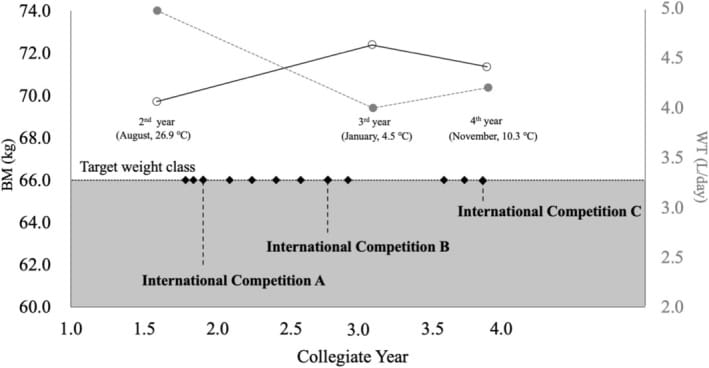
 ) with dashed lines. The black diamonds (◆) indicate the dates of competition in this weight class. Although the participant successfully met the weigh‐in requirement (BM ≤66.0 kg) on these dates, these specific weigh‐in mass values were not measured or recorded as experimental data points for this study. Environmental temperatures (°C) are indicated for each measurement point. BM, body mass; WT, water turnover.
Download the full article HERE.