
Injury Prevention Program on Traumatic Factors and Athletic Performance in juniors Judokas: the SLSTs Intervention
On World Judo Day, I wanted to share a project that grew directly from my experience in judo as an athlete, coach, and researcher.
Coaches organise technical training in many different ways, often based on experience, athlete level, and coaching philosophy. This raises an important question:
Can technical judo training itself be structured to better support movement quality, neuromuscular readiness, performance, and the reduction of modifiable injury-risk factors?
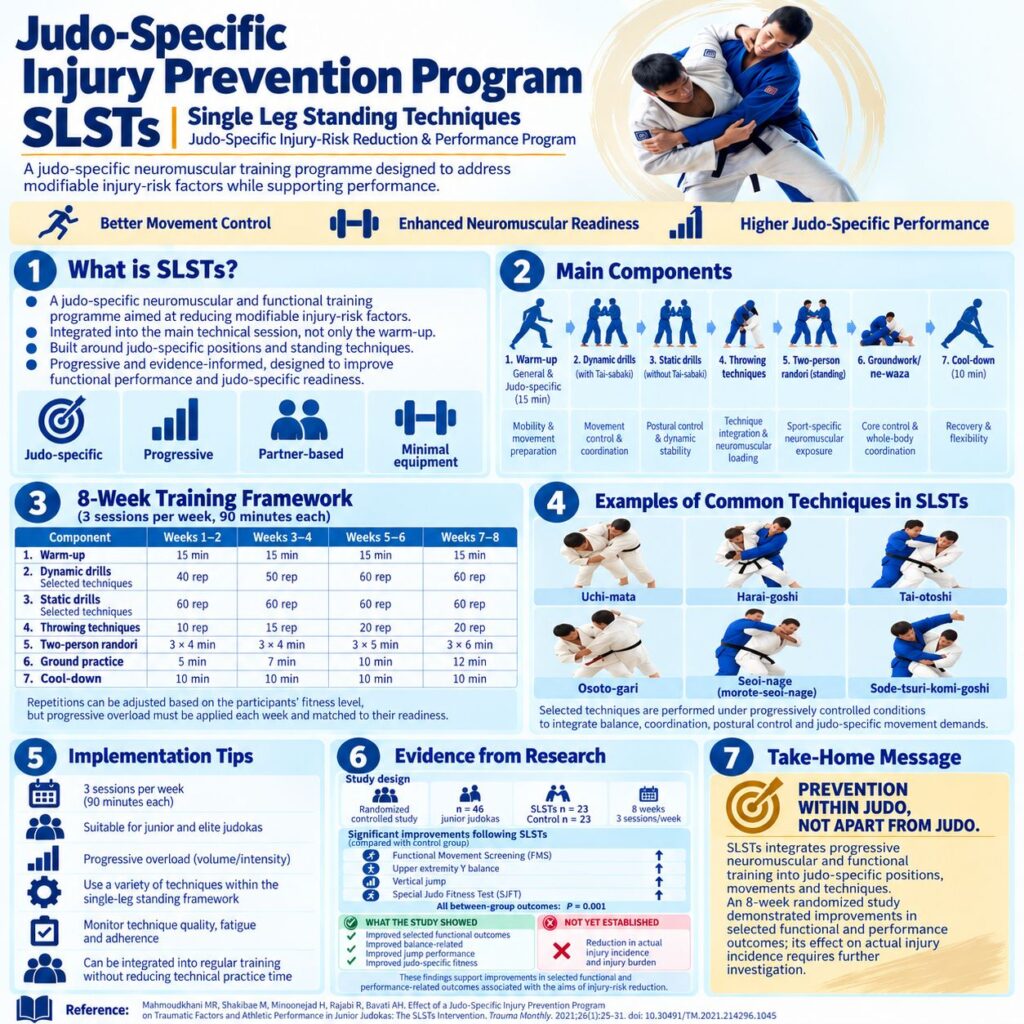
This question led to the development of SLSTs — Single Leg Standing Techniques.
Rather than adding a separate prevention routine, SLSTs integrates progressive neuromuscular and functional principles directly into judo-specific movements and technical practice.
For me, this is a practical example of research translation to practice, using research to improve how training is actually designed and delivered.
I hope the infographic encourages more discussion and research on how we can organise judo training more effectively.
For those interested in the evidence behind the program: The published SLSTs study is available on ResearchGate:
Mahmoudkhani, Mohammadreza & Shakibaee, Abolfazl & Minoonejad, Hooman & Rajabi, Reza & Barati, Amir. (2021). Effect of an Injury Prevention Program on Traumatic Factors and Athletic Performance in juniors Judokas: the SLSTs Intervention. Trauma Monthly. 26. 25-31. 10.30491/TM.2021.214296.1045.
ABSTRACT
Background: Judo has a higher risk of traumatic injuries during training. Thus, efficient training programs should be accomplished to decrease injury risk and improve performance.
Objectives: Given the necessity of developing injury prevention approaches in programming the training, this study aimed at investigating the effect of an Injury Prevention Program on Traumatic Factors and Athletic Performance in junior Judokas.
Methods: 46 subjects were randomly classified into 2 groups of experimental (N: 23) and control (N: 23) groups. For eight weeks, the experimental group attended a specific Judo functional training program designed by the researchers. The control group participated in the usual judo training program presented by the coaches. The exercises were accomplished 3 times per week for 90 minutes each session. The subjects participated in pre-and post-tests. To approve the data normality and compare the variables, Shapiro-wilk, ANCOVA analysis was implemented at the significant level of p˂ 0.05 using SPSS (version 21).
Results: The outcomes showed that the scores of functional movement screening (p = 0.001), upper extremity Y balance test (p = 0.001), vertical jump (p = 0.001), and special judo fitness test (p = 0.001) significantly increased among the experimental group.
Conclusions: This intervention can modify or decreases the injury risk factors and improves athletic performance and offers more efficiency and effectiveness rather than the common judo training programs.
Keywords: Traumatic injury, Functional Training, Functional Movement Screening
Download the full article HERE.
More articles about injury prevention in judo HERE.