
Effects of a 12-Week Technology-Assisted Neuromuscular Training Program on Judo-Specific Fitness, Shuttle Agility, and Plantar Pressure Distribution in Adolescent Judoka
Nagy A, Ordean MN, Grosu VT, Mancini N, Mancini S, Neagu SG, Grosu EF, Aducovschi D, Sabău AM, Mihaiu C. Effects of a 12-Week Technology-Assisted Neuromuscular Training Program on Judo-Specific Fitness, Shuttle Agility, and Plantar Pressure Distribution in Adolescent Judoka: A Pilot Study. J Funct Morphol Kinesiol. 2026 Oct 1;11(4):399. doi: 10.3390/jfmk11040399.
ABSTRACT
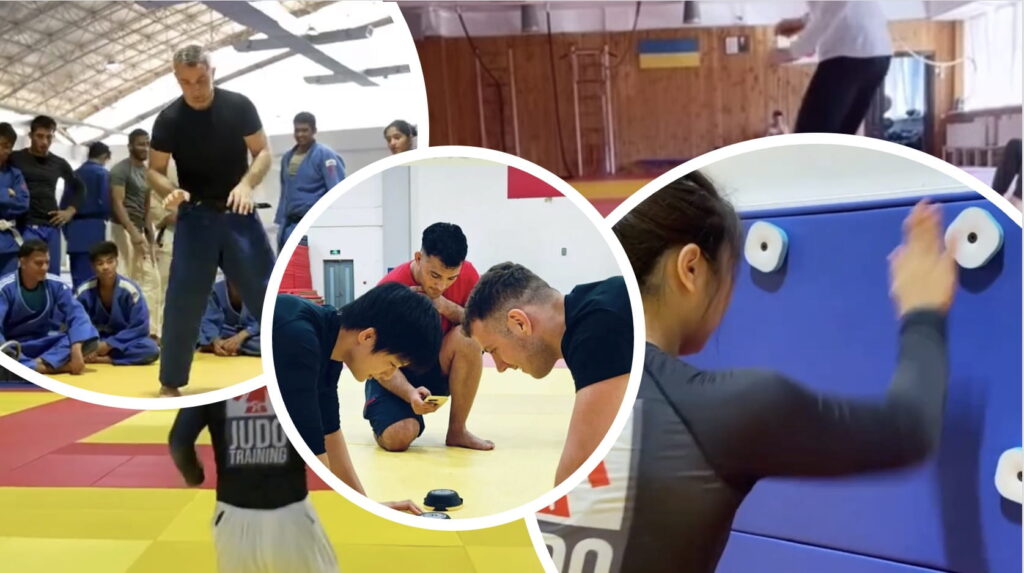
Background: Judo performance is multifactorial; judo-specific anaerobic fitness and shuttle agility speed have previously been investigated separately in adolescent judoka. What remains unexplored is whether a technology-assisted neuromuscular training program can concurrently influence these established performance measures alongside plantar-support biomechanics during throwing techniques such as ippon-seoi-nage. Pilot data integrating these domains are lacking in adolescent judoka. Methods: Twenty-four male judoka (aged 15-17 years; ≥3 years of experience) were allocated to an experimental group (EG; n = 12) or control group (CG; n = 12). The EG performed a 12-week technology-assisted neuromuscular training program (BlazePod light-sensor system) before each session; the CG continued standard uchi-komi. Three outcome domains were assessed at baseline and post-intervention: (i) judo-specific anaerobic fitness (SJFT); (ii) specific shuttle agility (BlazePod protocol); and (iii) static plantar pressure (BTS P-WALK baropodometer). Results: Retention was 100% with no adverse events. A 2 × 2 mixed-design ANOVA (group × time) showed a significant interaction for BlazePod shuttle agility performance (total hits: p = 0.026; average sprint time: p = 0.009), an effect that remained significant after a sensitivity analysis controlling for baseline anthropometric imbalance between groups. A significant interaction was also observed for the SJFT index (p = 0.028), but this effect did not survive the same sensitivity analysis (p = 0.10). No significant group × time interaction was detected for any of the six static plantar pressure regions assessed (all p > 0.09). Conclusions: In this pilot study, feasibility was supported by 100% retention and the absence of reported adverse events. The data provided preliminary evidence of a group × time interaction for judo-specific shuttle agility performance that remained significant after adjustment for baseline anthropometric imbalance, a less certain interaction for anaerobic fitness, and no detectable interaction for static plantar pressure distribution. These preliminary, hypothesis-generating findings support conducting a definitive, randomized, weight-stratified controlled trial.
Keywords: Special Judo Fitness Test; adolescent athletes; baropodometry; ippon-seoi-nage; judo; kuzushi; neuromuscular training; pilot study; plantar pressure; shuttle agility.
Download the full article HERE.